
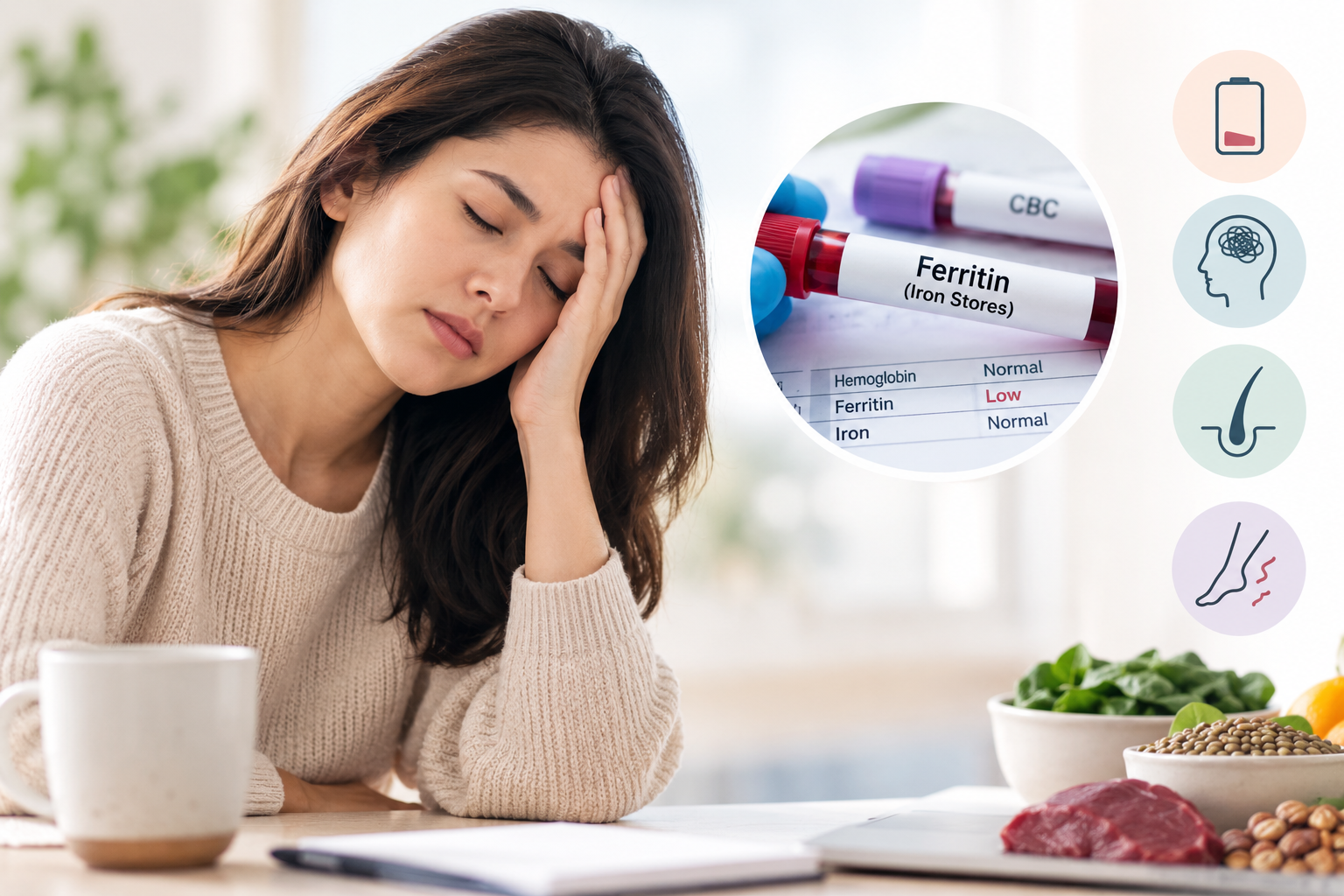
You are exhausted.
Getting through the afternoon feels harder than it should. Exercise takes more effort. You may have trouble concentrating, feel colder than usual, notice more hair in the shower, or experience restless legs at night.
So your doctor orders a complete blood count.
The result comes back:
Your hemoglobin is normal.
You are told that you are not anemic.
But then another laboratory result catches your attention:
Your ferritin is low.
Does that matter if hemoglobin is still normal?
Yes—it can.
Iron deficiency does not begin the day hemoglobin falls below the laboratory reference range. In many people, iron stores decline first. Hemoglobin may remain normal for some time while the body's iron reserves become progressively depleted.
This condition is often called iron deficiency without anemia, or non-anemic iron deficiency.
Research suggests that some people with low iron stores can experience fatigue and other symptoms even before anemia develops. Randomized controlled trials in non-anemic women with low ferritin have found improvements in fatigue after iron replacement, although the response is not identical for every patient. A systematic review of 18 randomized trials involving 1,170 iron-deficient but non-anemic adults found that iron supplementation reduced subjective fatigue, although improvements in objective physical performance were less consistent. (PubMed)
The important lesson is simple:
A normal hemoglobin level does not necessarily mean your iron status is optimal—or even adequate.
To understand why, we need to look beyond the CBC.
Ferritin is a protein that stores iron.
Think of hemoglobin as the iron currently being used to transport oxygen in your red blood cells, while ferritin represents part of your body's iron reserve.
Your body needs iron for far more than making hemoglobin.
Iron is involved in:
Dietary iron is therefore important not only for preventing anemia, but also for maintaining cellular processes throughout the body.
Ferritin is one of the most useful laboratory markers for assessing iron stores. The World Health Organization recognizes ferritin as a good biomarker of iron status when interpreted appropriately. (World Health Organization)
This distinction becomes important because your body can begin drawing down stored iron while still maintaining enough hemoglobin to keep the CBC within the laboratory's normal range.
Eventually, if iron depletion becomes severe enough, hemoglobin production may fall and iron-deficiency anemia develops.
But there is often a period before that happens.
That is the window in which someone may have:
Low ferritin + normal hemoglobin.
The terms iron deficiency and iron-deficiency anemia are often used interchangeably.
They should not be.
Iron deficiency means the body's iron supply is insufficient to meet physiologic needs.
Iron-deficiency anemia represents a later stage in which iron depletion has become significant enough to impair hemoglobin production and lower the hemoglobin concentration.
One clinical review estimates that iron deficiency without anemia may be at least twice as common as iron-deficiency anemia, yet it is less frequently recognized. (PubMed Central (PMC))
The progression can be thought of approximately like this:
Ferritin decreases.
Hemoglobin may still be completely normal.
Ferritin remains low and transferrin saturation may fall.
Some red-cell indices may begin changing.
Hemoglobin may still remain within range.
Iron availability is no longer sufficient to maintain normal red blood cell production.
Hemoglobin falls.
This is why waiting until someone becomes anemic can miss an earlier stage of iron deficiency.
The most obvious role of iron is oxygen transport.
But iron is also involved in cellular energy production.
Your mitochondria—the structures inside cells that generate much of the energy your body uses—depend on iron-containing proteins and enzymes.
Iron is also involved in muscle metabolism and neurologic function.
Therefore, it is biologically plausible that depleted iron stores could affect energy and function even before oxygen-carrying capacity falls enough to meet the definition of anemia.
Clinical research supports this possibility.
A randomized controlled trial published in the BMJ studied 144 non-anemic women with unexplained fatigue. Women receiving oral iron experienced a greater reduction in fatigue than women receiving placebo. The benefit appeared primarily among women whose ferritin was 50 µg/L or lower. (BMJ)
Another randomized trial studied 198 menstruating women with fatigue, ferritin below 50 µg/L, and hemoglobin above 12 g/dL. After 12 weeks, fatigue decreased by approximately 48% in the iron-treatment group compared with approximately 29% in the placebo group. (PubMed)
A systematic review of randomized trials reached a similar overall conclusion: iron replacement in iron-deficient, non-anemic adults was associated with reduced self-reported fatigue, although objective exercise performance did not consistently improve. (PubMed)
This does not mean every tired person with ferritin of 40 automatically needs iron.
Fatigue has many possible causes.
But it does mean low iron stores deserve attention rather than being dismissed simply because hemoglobin has not fallen yet.
Iron deficiency without anemia can be difficult to recognize because the symptoms are often nonspecific.
Possible symptoms can include:
Not every person with low ferritin experiences these symptoms, and every symptom on this list has many other possible causes.
For example, fatigue may also result from:
That is why symptoms should be interpreted together with laboratory findings and medical history.
The key is not to assume that ferritin explains everything.
The key is also not to ignore it.
Many women with iron deficiency describe difficulty concentrating or feeling mentally slower.
There is some research supporting a relationship between iron status and cognitive performance.
A systematic review examining women of childbearing age found evidence suggesting iron deficiency may be associated with fatigue and selected cognitive changes, while several intervention studies reported improvements in certain cognitive measures after iron treatment. However, the authors emphasized that the studies were heterogeneous and that stronger research is needed. (PubMed)
One controlled study of young women found that women who were iron sufficient performed better on several cognitive tasks than women with iron-deficiency anemia, while non-anemic iron-deficient women generally performed between the two groups. Improvements in iron status during treatment were associated with improvements in cognitive performance. (PubMed)
This does not mean every episode of brain fog is caused by ferritin.
But in someone with unexplained fatigue and concentration problems—especially a menstruating woman—iron status is worth checking.
Hair loss is one of the most common reasons patients begin researching ferritin.
The relationship is real enough to investigate, but the science is more complicated than many online articles suggest.
A 2022 systematic review and meta-analysis involving more than 10,000 women found that women with nonscarring hair loss had lower ferritin levels on average than women without hair loss. (PubMed)
Other studies have reported associations between low ferritin and telogen hair shedding. (PubMed)
However, not every study has found that iron deficiency is more common among women with hair loss than among controls, and there is no universally accepted ferritin number that guarantees hair regrowth. (PubMed)
Therefore, claims such as:
“Your ferritin must be 70 for your hair to grow”
should be treated cautiously.
Hair loss can also be caused by:
Low ferritin may be one contributor.
It should not automatically be assumed to be the only cause.
Restless legs syndrome is another situation in which iron status deserves special attention.
Patients may describe:
Iron recommendations for restless legs are different from the general definition of iron deficiency.
The American Academy of Sleep Medicine recommends evaluating ferritin and transferrin saturation in patients with clinically significant restless legs syndrome. Expert consensus cited in its current guideline suggests considering iron therapy in adults with ferritin at or below 75 ng/mL or transferrin saturation below 20%, depending on the clinical situation. (PubMed)
This is a perfect example of why there is no single ferritin cutoff that applies to every medical condition.
This is one of the most confusing areas for patients.
You may receive a laboratory report with a reference range that begins around:
10, 12, 15, or 20 ng/mL
and conclude that a ferritin of 18 must be fine because it does not have an “L” beside it.
Clinical interpretation is more nuanced.
For otherwise healthy adults, the World Health Organization uses a ferritin concentration below 15 µg/L as an indicator of iron deficiency. (World Health Organization)
Remember:
1 ng/mL ferritin = 1 µg/L ferritin
numerically.
Many clinical reviews use a threshold below approximately 30 ng/mL as strongly suggestive of depleted iron stores in the absence of inflammation. (PubMed Central (PMC))
But even this cannot be interpreted in isolation.
Why?
Because ferritin is also an acute-phase reactant.
Ferritin rises during inflammation.
This means someone with:
may have a ferritin level that appears normal—or even elevated—despite limited iron availability.
Inflammatory signaling increases the hormone hepcidin, which can reduce intestinal iron absorption and trap iron inside storage cells.
The result can be a situation in which iron exists in the body but is not adequately available to tissues.
This is sometimes called functional iron deficiency.
The WHO therefore recommends interpreting ferritin differently when infection or inflammation is present. In adults with inflammation, ferritin below approximately 70 µg/L may still indicate iron deficiency, depending on the clinical context. (World Health Organization)
Disease-specific definitions may use still different thresholds. For example, chronic heart failure, chronic kidney disease, and inflammatory bowel disease often require ferritin to be interpreted together with transferrin saturation. (PubMed)
This is why looking only at ferritin can sometimes be misleading.
If low ferritin or iron deficiency is suspected, useful tests may include:
The CBC includes:
Hemoglobin tells us whether anemia is present.
MCV describes average red blood cell size.
MCH reflects the amount of hemoglobin per red blood cell.
RDW describes variability in cell size.
Early iron deficiency may sometimes begin altering these indices before hemoglobin becomes clearly abnormal. (PubMed Central (PMC))
Ferritin is the primary marker of stored iron.
A clearly low ferritin is strong evidence that iron stores are depleted.
But a normal ferritin does not always rule out iron deficiency if inflammation is present.
Serum iron measures circulating iron at a particular moment.
It can fluctuate considerably and should generally not be used alone to diagnose iron deficiency. (PubMed Central (PMC))
A normal serum iron level therefore does not necessarily mean your iron stores are adequate.
TIBC indirectly reflects the amount of transferrin available to bind iron.
In classic absolute iron deficiency, TIBC may increase.
Transferrin saturation estimates how much circulating transferrin is actually carrying iron.
A TSAT below approximately 20% is commonly used as evidence of inadequate iron availability, particularly when ferritin interpretation is complicated by inflammation. (PubMed Central (PMC))
C-reactive protein is not an iron test.
It is an inflammatory marker.
However, knowing whether inflammation is present can help determine whether ferritin may be artificially elevated.
Depending on the clinical situation, clinicians may occasionally use:
These are not necessary for every patient but can help clarify complicated cases.
Finding low ferritin is only the beginning.
The next question should be:
Why are your iron stores low?
There are four broad possibilities:
Often, more than one factor is present.
For menstruating women, menstrual blood loss is one of the most important causes of iron depletion.
Heavy menstrual bleeding may look like:
A review of clinical guidelines notes that heavy menstrual bleeding can lead to both iron deficiency and iron-deficiency anemia, yet recommendations for routine iron testing remain inconsistent. (PubMed)
ACOG also recognizes that low ferritin can occur in patients with heavy menstrual bleeding even before anemia develops and recommends ferritin assessment in appropriate young patients with heavy menstrual bleeding. (ACOG)
If a patient repeatedly takes iron but ferritin keeps falling, ongoing menstrual blood loss needs to be addressed.
Replacing iron without investigating the bleeding is like repeatedly filling a bucket without repairing the leak.
Potential causes of heavy bleeding may include:
Persistent heavy menstrual bleeding deserves appropriate gynecologic evaluation.
Iron requirements increase substantially during pregnancy because iron is needed for:
Pregnancy can therefore significantly reduce iron reserves.
Blood loss during delivery can further decrease ferritin.
A woman may leave pregnancy with hemoglobin that eventually returns to normal but with iron stores that remain depleted.
If she then experiences:
iron depletion may persist for a long time.
Regular blood donation is another underappreciated source of iron loss.
Red blood cells contain a substantial amount of iron.
Frequent donors can gradually deplete iron stores even when hemoglobin remains adequate enough to meet donation requirements.
Therefore, asking simply:
“Have you ever had anemia?”
may miss the issue.
A better history also asks:
“How often do you donate blood?”
Iron comes in two general dietary forms:
Found primarily in:
Heme iron is generally more efficiently absorbed.
Found in:
Nonheme iron is valuable, but its absorption is more strongly affected by the rest of the meal.
The NIH Office of Dietary Supplements estimates iron bioavailability at approximately 14–18% from mixed diets containing meat and vitamin C, compared with approximately 5–12% from vegetarian diets. (Office of Dietary Supplements)
That does not mean vegetarian diets automatically cause iron deficiency.
It means iron intake and food combinations deserve more attention when dietary iron comes mainly from plants.
Vitamin C improves absorption of nonheme iron.
Food combinations might therefore include:
The NIH specifically recognizes vitamin C as an enhancer of nonheme iron absorption. (Office of Dietary Supplements)
Coffee and tea contain polyphenols that can interfere with nonheme iron absorption.
This does not mean you must give up coffee forever.
Timing can matter.
The American Gastroenterological Association advises avoiding tea and coffee close to oral iron supplementation because they can inhibit absorption. (Clinical Gastroenterology and Hepatology)
This becomes especially relevant in someone who:
Several small factors can add up.
Sometimes the problem is not how much iron someone eats.
It is how much they absorb.
Iron is primarily absorbed in the proximal small intestine, and several gastrointestinal conditions can interfere with this process.
Important possibilities include:
Celiac disease damages the small intestinal lining and can impair micronutrient absorption.
Iron deficiency can occasionally be one of the first laboratory abnormalities.
Research has found increased rates of celiac disease among some patients presenting with low ferritin, including patients who were not yet anemic. (PubMed)
Chronic H. pylori infection has also been associated with unexplained iron deficiency in some patients. (PubMed)
Adequate gastric physiology helps make dietary iron available for absorption.
Autoimmune gastritis can interfere with both iron and vitamin B12 status.
In some patients, iron deficiency can develop before B12 deficiency becomes obvious.
Crohn's disease and ulcerative colitis can contribute to iron deficiency through:
Ferritin can be especially difficult to interpret in inflammatory bowel disease because inflammation itself raises ferritin.
Procedures that bypass or alter the stomach and upper small intestine can significantly affect iron absorption.
The AGA recommends considering intravenous iron when oral iron is unlikely to be adequately absorbed, including certain patients who have undergone bariatric procedures. (Gastroenterology.org)
Proton pump inhibitors, or PPIs, include medications used to reduce stomach acid.
Examples include medications such as:
Reduced gastric acidity can theoretically interfere with absorption of nonheme iron.
The clinical significance varies from person to person, but long-term acid suppression deserves consideration when unexplained or treatment-resistant iron deficiency is present—especially when other risk factors coexist.
This does not mean a patient should stop a PPI on their own.
PPIs may be medically necessary.
Medication changes should be discussed with the prescribing clinician.
Iron deficiency is not always nutritional.
Chronic gastrointestinal bleeding can gradually deplete iron stores.
Potential sources include:
The significance of GI evaluation depends heavily on age, sex, menstrual status, symptoms, and medical history.
Iron deficiency in a young woman with very heavy periods has a different probability profile from new iron deficiency in a postmenopausal woman or adult man.
New or unexplained iron deficiency in non-menstruating adults deserves appropriate medical investigation rather than simply taking supplements indefinitely.
Not automatically.
Iron is essential—but excessive iron can also be harmful.
Before supplementing, it is helpful to establish:
This is particularly important in people with:
More iron is not always better.
The goal is iron sufficiency, not iron excess.
Traditional iron protocols sometimes used multiple doses per day.
Current understanding of hepcidin physiology has changed that thinking.
After an oral iron dose, hepcidin rises and can temporarily reduce additional iron absorption.
The American Gastroenterological Association's 2024 Clinical Practice Update advises giving oral iron no more than once daily and notes that every-other-day dosing may be better tolerated for some patients while producing similar absorption. (Gastroenterology.org)
This may also reduce common gastrointestinal side effects such as:
The ideal formulation and dose should be individualized.
Several possibilities should be considered.
When oral iron is poorly tolerated, does not improve ferritin, or is unlikely to be absorbed, intravenous iron may sometimes be considered.
The AGA recommends IV iron when oral iron is not tolerated, ferritin fails to improve after an adequate oral trial, or a condition makes oral absorption unlikely. (Gastroenterology.org)
A Cochrane-derived systematic review found that IV iron can improve fatigue in some non-anemic iron-deficient adults, although the overall quality of evidence was limited and mild adverse effects were more frequent. (PubMed)
IV iron is therefore a medical treatment—not simply a wellness infusion for anyone who feels tired.
Hemoglobin and ferritin do not recover at exactly the same rate.
If someone is already anemic, hemoglobin may begin improving before total iron stores have been completely replenished.
Likewise, a person with normal hemoglobin but very depleted ferritin may need time to rebuild storage iron.
Follow-up testing is important.
A clinical review of non-anemic iron deficiency recommends repeating iron studies after approximately 60–90 days of oral replacement and investigating further if iron deficiency does not correct. (PubMed Central (PMC))
The exact timing depends on:
Symptoms and laboratory trends should both be considered.
This is probably the question patients ask most frequently.
Unfortunately, there is no single evidence-based ferritin target that applies to everyone.
Different thresholds are used for:
Some fatigue studies have included patients with ferritin below 50 ng/mL and demonstrated benefit from iron therapy. (BMJ)
But that does not prove that every person's ferritin must exceed 50.
Similarly, some hair-loss literature proposes higher ferritin targets, but research remains inconsistent.
For general clinical assessment, a clearly low ferritin—particularly below approximately 15–30 ng/mL in a person without inflammation—should raise concern for depleted iron stores.
Beyond that, ferritin should be interpreted together with:
Instead of chasing one “perfect” number, the better goal is to correct true iron deficiency, address the cause, and monitor whether iron status remains stable.
It is equally important not to blame all fatigue on ferritin.
If iron status improves but fatigue remains severe, other causes deserve evaluation.
Depending on the individual, this may include:
Especially in people with:
Low vitamin D is common and may coexist with other nutritional deficiencies.
Consider:
Ask about:
Persistent fatigue may accompany:
A comprehensive evaluation is usually more useful than assuming one abnormal laboratory value explains the entire picture.
Consider a 38-year-old woman who reports:
Her laboratory results show:
Hemoglobin: 12.8 g/dL — normal
MCV: 84 fL — normal
Ferritin: 11 ng/mL — low
She technically does not meet the definition of anemia.
But that does not make the ferritin unimportant.
Her low ferritin indicates depleted iron stores.
The next step should not simply be:
“Take iron forever.”
The more useful questions include:
This is the difference between treating a laboratory number and understanding why the laboratory number became abnormal.
Talk with a healthcare professional if you have persistent fatigue together with:
New iron deficiency in adult men and postmenopausal women deserves particular attention because chronic blood loss or gastrointestinal disease may need to be ruled out.
Do not simply assume it is dietary.
You can have normal hemoglobin and still have iron deficiency.
Hemoglobin tells us whether iron depletion has progressed far enough to cause anemia.
Ferritin helps us understand your stored iron.
When iron stores decline, symptoms such as fatigue may occur before hemoglobin drops below the laboratory reference range.
Research in non-anemic iron-deficient women has shown that correcting iron deficiency can improve fatigue in selected patients. (PubMed)
But low ferritin is not the final diagnosis.
The deeper question is:
Why are your iron stores low?
For many women, heavy menstrual bleeding is the major contributor.
For others, the issue may involve:
A useful evaluation therefore goes beyond hemoglobin alone.
Looking at ferritin, transferrin saturation, CBC patterns, menstrual history, nutrition, gastrointestinal health, inflammation, and other possible causes of fatigue can provide a much more complete picture.
If your blood work says you are “not anemic” but you continue to feel exhausted, that does not automatically mean iron is the answer.
But it may mean the investigation should not stop at hemoglobin.
Yes. Iron stores can become depleted before hemoglobin falls low enough to meet the definition of anemia. This is commonly called iron deficiency without anemia.
Research suggests that iron deficiency without anemia can contribute to fatigue in some people. Randomized trials and systematic reviews have found that iron treatment may reduce fatigue in selected non-anemic iron-deficient adults. (PubMed)
Interpretation depends on inflammation and clinical context. WHO defines ferritin below 15 µg/L as iron deficiency in otherwise healthy adults, while many clinical reviews consider levels below approximately 30 ng/mL strongly suggestive of depleted iron stores. (World Health Organization)
Yes. Ferritin is an acute-phase reactant and can rise during infection or inflammation. In these situations, transferrin saturation and inflammatory markers may help clarify iron status. (PubMed)
Yes. Repeated menstrual blood loss can gradually deplete stored iron before anemia becomes obvious. Heavy menstrual bleeding is an important risk factor for iron deficiency. (PubMed)
Low ferritin has been associated with some forms of nonscarring hair loss in women, but the research is inconsistent and hair loss has many possible causes. There is no universally accepted ferritin target that guarantees hair regrowth. (PubMed)
Depending on the clinical picture, useful tests may include CBC, serum iron, TIBC or transferrin, transferrin saturation, and CRP. Additional testing may be needed to determine why iron is low.
This article is intended for educational purposes only and is not a substitute for individualized medical diagnosis, treatment, or medical advice. Fatigue, low ferritin, abnormal bleeding, hair loss, and other symptoms can have multiple causes. Iron supplementation should be individualized, particularly because excessive iron can be harmful. Persistent iron deficiency, unexplained blood loss, severe fatigue, pregnancy, or iron deficiency that does not respond to treatment should be evaluated by an appropriately qualified healthcare professional.

