
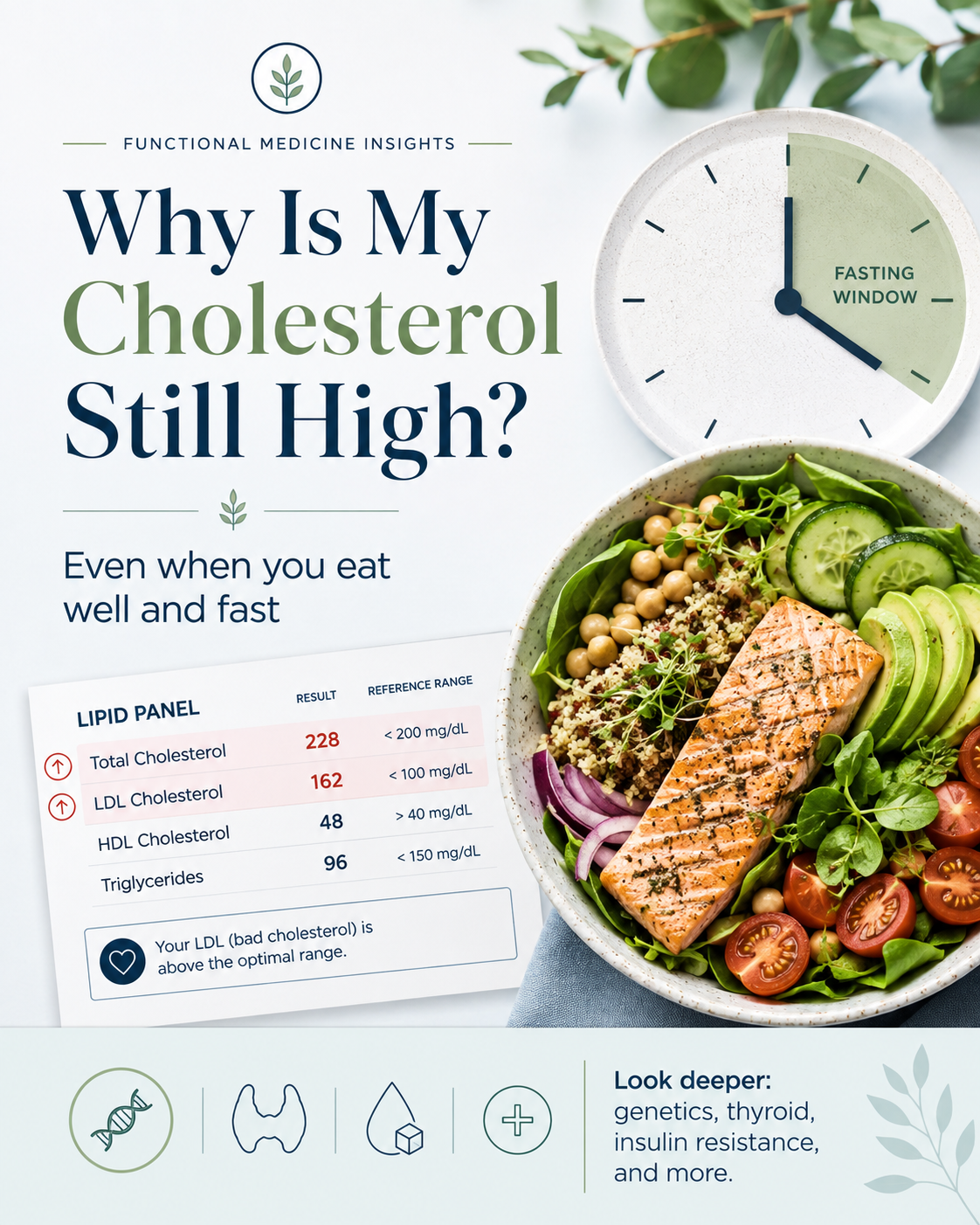
You eat carefully.
You avoid processed foods, limit sugar, exercise regularly, and perhaps practice intermittent fasting for 16, 18, or even 20 hours a day.
Then your laboratory results come back.
Your cholesterol is still high.
Maybe your LDL cholesterol is significantly elevated. Your triglycerides may also be high. Perhaps your fasting glucose or HbA1c is beginning to rise despite all the work you have put into improving your health.
It can be confusing—and frustrating.
Many patients immediately assume one of two things:
“I must still be eating something wrong.”
Or:
“It must just be genetic, so there is nothing I can do.”
Neither conclusion tells the whole story.
High cholesterol is not simply a reflection of how much cholesterol or fat you eat. Your lipid levels are influenced by genetics, liver metabolism, insulin sensitivity, thyroid function, dietary fat composition, kidney health, medications, physical activity, sleep, and other physiologic factors.
Intermittent fasting can be helpful for some people, but fasting longer does not automatically produce lower cholesterol.
Recent randomized-trial evidence suggests intermittent fasting can improve weight and several metabolic markers in some people, but overall results are often similar to traditional calorie-restricted diets, and different fasting strategies produce different effects on cholesterol and triglycerides. (BMJ)
So when someone has been eating well and fasting consistently but their numbers remain abnormal, the most useful question is usually not:
“How can I restrict my diet even more?”
A better question is:
What is driving this metabolic pattern in the first place?
That question can lead to a much more productive evaluation.
Cholesterol itself is not something your body is trying to eliminate.
It is an essential molecule used in cell membranes and as a precursor for bile acids, steroid hormones, and other important compounds.
Because cholesterol cannot freely dissolve in blood, it is transported inside particles called lipoproteins.
A standard lipid panel usually reports:
These numbers are useful, but they do not always tell the complete story.
LDL-C tells us how much cholesterol is being carried inside LDL particles.
It does not directly tell us how many atherogenic particles are circulating.
This is where Apolipoprotein B, or ApoB, can add useful information.
Each major atherogenic lipoprotein particle carries one ApoB molecule. ApoB therefore provides an estimate of the total concentration of atherogenic particles circulating in the bloodstream.
The National Lipid Association notes that ApoB can more accurately reflect atherogenic particle burden than LDL-C in some situations, particularly when LDL-C and particle concentration do not match. (Lipid Journal)
This discordance is particularly relevant in people with:
This is one reason looking only at total cholesterol may miss important information.
If you eat well, exercise regularly, and still have very high LDL cholesterol, genetics may be an important part of the picture.
For people with severely elevated LDL, the most important inherited condition to consider is familial hypercholesterolemia (FH). Genes commonly associated with FH include:
These genes directly affect how LDL particles are produced or cleared from the bloodstream. This is why some people can maintain a healthy lifestyle and still have very high cholesterol.
MTHFR is another gene frequently discussed in functional medicine, but it is important to understand that it is not a primary familial hypercholesterolemia gene like LDLR, APOB, or PCSK9.
MTHFR mainly affects folate metabolism and homocysteine regulation.
The two most commonly discussed variants are:
Some studies have found associations between the MTHFR C677T variant and modestly higher LDL cholesterol, total cholesterol, homocysteine, and cardiovascular risk. However, the evidence is not strong enough to say that an MTHFR variant directly causes high cholesterol.
A more useful approach is to look at the patient's actual metabolic markers.
If an MTHFR variant is already known, consider evaluating:
The key principle is:
Treat the physiology, not simply the genetic variant.
For someone with very high LDL, MTHFR should be viewed as one possible contributor to the broader cardiovascular picture—not the primary explanation.
Other important genetic and lipid markers may include ApoB, Lp(a), family history, and testing for familial hypercholesterolemia when appropriate.
Genetics can strongly influence cholesterol levels. LDLR, APOB, and PCSK9 directly affect LDL metabolism, while MTHFR may influence homocysteine and cardiovascular risk indirectly.
A comprehensive interpretation of genetics, laboratory markers, nutrition, and metabolic health is more useful than focusing on a single gene.
This distinction matters.
The 2026 ACC/AHA multisociety dyslipidemia guideline identifies adults with LDL-C of 190 mg/dL or greater as having high lifetime cardiovascular risk and recommends active evaluation and management rather than simply relying on a short-term cardiovascular risk calculator. (JACC)
That means an LDL-C of:
195
is different from:
135
And an LDL-C of:
250 or 300
deserves even more attention.
Extremely elevated cholesterol should not be dismissed simply because someone:
Atherosclerosis can progress silently for many years.
Another important marker is:
Lp(a) is an LDL-like particle with an additional protein called apolipoprotein(a).
Unlike many traditional cardiovascular risk factors, Lp(a) levels are largely genetically determined.
Diet and exercise generally have relatively little effect on Lp(a).
The updated 2026 ACC/AHA dyslipidemia guideline recommends measuring Lp(a) at least once during adulthood to help identify inherited cardiovascular risk. (JACC)
This is especially useful when there is:
A patient can therefore eat extremely well and still have an important cardiovascular risk factor that diet alone cannot explain.
One of the most important metabolic patterns we evaluate is insulin resistance.
Many patients think:
“My glucose is normal, so I cannot be insulin resistant.”
Unfortunately, glucose does not always tell the entire story.
The pancreas may compensate for insulin resistance by producing more insulin.
For a period of time, glucose may remain relatively normal because the body is using increasingly large amounts of insulin to control it.
Eventually, glucose may start rising.
But metabolic changes may have been developing for years.
Insulin resistance affects fat metabolism as well as glucose metabolism.
When adipose tissue becomes less responsive to insulin, more fatty acids can reach the liver.
The liver may then increase the production of triglyceride-rich VLDL particles.
This often contributes to a metabolic lipid pattern involving:
This is sometimes called atherogenic dyslipidemia.
A patient may therefore have a cholesterol problem that is closely connected to glucose and insulin metabolism rather than simply dietary cholesterol intake.
Depending on the individual, useful markers may include:
Fasting glucose
HbA1c
Fasting insulin
C-peptide
Triglycerides
HDL-C
ApoB
ALT and GGT
Looking at these markers together may provide much more information than looking at fasting glucose alone.
Intermittent fasting has become one of the most popular metabolic-health strategies.
And there is legitimate research supporting it.
Fasting strategies can help some people:
A 2024 umbrella review of randomized controlled trials found that intermittent fasting was associated with modest improvements in several cardiometabolic measures among adults with overweight or obesity, including LDL-C, triglycerides, total cholesterol, fasting insulin, and waist circumference in some analyses. (PubMed)
However, this does not mean that fasting works equally well for everyone.
A major 2025 systematic review and network meta-analysis of randomized clinical trials found that intermittent fasting strategies were generally comparable with continuous calorie restriction for weight loss and cardiometabolic outcomes. Different fasting approaches produced somewhat different results, but no single strategy proved universally superior. (BMJ)
In other words:
Fasting can be useful, but fasting is not a guarantee of normal cholesterol.
This is an important distinction.
Someone may begin with:
12-hour fasting
and feel better.
Then they move to:
14 hours
then:
16 hours
then:
18 hours
and eventually:
20 hours or one meal a day.
The assumption becomes:
If fasting is healthy, longer fasting must be healthier.
Human metabolism does not always work that way.
There is no universal fasting window that is optimal for every person.
A person's response may depend on:
If someone has practiced prolonged daily fasting for months or years and their:
then simply making the fasting window longer may not address the underlying problem.
It may be time to rethink the strategy.
Stress physiology is another piece of metabolic health.
Cortisol is one of the primary hormones involved in the body's stress response.
Cortisol is not inherently harmful.
It helps maintain blood pressure, regulate immune activity, and mobilize energy when the body needs it.
During stress, cortisol can support hepatic glucose production so that glucose remains available for the brain and muscles.
That is an appropriate survival response.
However, persistent disruption of stress physiology may contribute to metabolic problems in susceptible individuals.
Long-term glucocorticoid excess is well known to contribute to:
Everyday psychological stress is much more complicated than a disease state such as Cushing syndrome, so it would be inaccurate to assume that stress is automatically the cause of someone's high cholesterol.
But it is equally inappropriate to ignore sleep and chronic stress when evaluating metabolic health.
Consider two people following the same 18-hour fasting schedule.
Sleeps eight hours.
Exercises regularly.
Has adequate protein and calorie intake.
Has reasonable work stress.
Feels energetic.
Sleeps five to six hours.
Works under intense pressure.
Uses caffeine throughout the day to maintain energy.
Exercises intensely.
Restricts calories.
Fast for 18–20 hours daily.
These two people may technically follow the same “intermittent fasting protocol.”
Physiologically, they are not in the same situation.
This is why metabolic health requires context.
One secondary cause of high cholesterol that should not be overlooked is:
Thyroid hormones help regulate:
When thyroid function declines, the liver may clear LDL particles less efficiently.
As a result, hypothyroidism is commonly associated with increases in:
Research consistently supports the association between overt hypothyroidism and hyperlipidemia. (PubMed)
This is why thyroid evaluation can be important when cholesterol is unexpectedly high.
Common initial laboratory testing may include:
TSH
and when appropriate:
Free T4
Additional thyroid evaluation may be warranted depending on symptoms and medical history.
Symptoms can include:
However, symptoms alone cannot diagnose thyroid disease.
Laboratory evaluation matters.
When someone tells us:
“I eat extremely healthy.”
the next question should often be:
“What exactly are you eating?”
One person's healthy diet may look like:
Another person's healthy diet may be:
Both people may avoid sugar and ultra-processed food.
But the diets can have very different effects on LDL cholesterol.
Low-carbohydrate nutrition can be very effective for certain metabolic problems.
Some people experience:
But there is a subset of people whose LDL cholesterol rises substantially after adopting a high-fat, carbohydrate-restricted diet.
That does not happen to everyone.
But when it does happen, the change should not simply be ignored because glucose or triglycerides improved.
If LDL-C and ApoB rise significantly after a major dietary change, it is worth examining:
Changing fat quality can sometimes substantially alter the response.
Reducing processed foods is valuable, but fat quality still matters.
For patients with elevated LDL, nutrition recommendations commonly emphasize replacing some saturated fats with unsaturated fats rather than simply eliminating all dietary fat.
Examples of foods rich in unsaturated fats include:
The National Lipid Association continues to emphasize dietary patterns lower in saturated fat and richer in vegetables, fruits, fiber-rich foods, whole grains, legumes, nuts, seeds, and unsaturated fats for dyslipidemia management. (Lipid.org)
Another question worth asking is:
How much fiber are you actually eating?
Soluble and viscous fibers can contribute to LDL reduction through several mechanisms, including effects on bile acid and cholesterol metabolism.
Useful sources include:
This becomes especially important in diets that heavily restrict plant carbohydrates.
Low carbohydrate does not automatically mean low fiber—but poorly planned low-carbohydrate diets often are.
LDL and triglycerides are both included in a lipid panel, but they often point toward different metabolic processes.
High triglycerides are commonly associated with:
For example:
LDL-C: 230 mg/dL
Triglycerides: 70 mg/dL
HbA1c: normal
is metabolically different from:
LDL-C: 150 mg/dL
Triglycerides: 350 mg/dL
HbA1c: elevated
Fasting insulin: elevated
Both deserve attention.
But they may not have the same underlying driver.
Your liver is deeply involved in both glucose and lipid metabolism.
Among many other functions, the liver:
This is one reason metabolic fatty liver frequently occurs alongside:
Common laboratory markers that may help assess the broader picture include:
ALT
AST
GGT
Alkaline phosphatase
Bilirubin
However, normal liver enzymes do not necessarily exclude metabolic liver disease.
They are pieces of the puzzle rather than the entire picture.
Kidney disease can affect lipid metabolism.
Certain kidney disorders, particularly those associated with significant urinary protein loss, may produce major elevations in cholesterol and triglycerides.
This is why an unexplained or dramatic change in cholesterol sometimes warrants evaluation of:
Looking only at the lipid panel may miss the secondary cause.
Medication history matters too.
Certain medications may affect glucose or lipid metabolism, including some:
This does not mean you should stop a medication when cholesterol rises.
Medication decisions should always be discussed with the prescribing clinician.
But if your cholesterol changed substantially after starting or changing a medication, that timing deserves attention.
Not everyone needs every possible blood test.
The goal is to identify the underlying metabolic pattern.
Depending on your history, a more complete evaluation may include:
Total cholesterol
LDL-C
HDL-C
Triglycerides
Non-HDL cholesterol
ApoB
Lp(a)
Fasting glucose
HbA1c
Fasting insulin
C-peptide, when clinically appropriate
TSH
Free T4
Additional testing depending on the clinical picture
ALT
AST
GGT
Alkaline phosphatase
Bilirubin
Creatinine
eGFR
Urinalysis
Cystatin C, when appropriate
Depending on the individual, clinicians may also consider:
hs-CRP
Blood pressure
Waist circumference
Family history
Genetic testing
Coronary artery calcium testing in appropriately selected patients
The 2026 ACC/AHA dyslipidemia guideline places greater emphasis on individualized risk assessment, including Lp(a), ApoB in selected patients, and coronary artery calcium when additional risk clarification is needed. (professional.heart.org)
If your cholesterol, triglycerides, or blood sugar remain abnormal despite long-term fasting, consider stepping back from the question:
“Should I fast longer?”
Instead, ask:
If LDL is above 190 mg/dL, this deserves proper medical assessment regardless of how healthy your lifestyle appears. (JACC)
ApoB can help clarify the total burden of circulating atherogenic particles. (Lipid Journal)
Current U.S. guidance recommends at least one adult measurement. (American College of Cardiology)
Elevated triglycerides can point toward insulin resistance, liver metabolism, diet, alcohol, medications, or genetic factors.
Glucose may look relatively normal while insulin is already elevated.
Look at the trend, not just a single result.
Hypothyroidism is an established secondary cause of elevated LDL. (PubMed)
Pay attention to saturated fat, fiber, protein, refined carbohydrates, and total energy intake.
Both resistance training and aerobic exercise support cardiometabolic health.
Sleep is part of metabolic health, not an optional extra.
Your laboratory trend can be more useful than a nutrition ideology.
Fasting does not have to mean 18 or 20 hours every day.
Some individuals may do very well with a consistent overnight fasting window—for example, approximately 12–14 hours—combined with:
Others may tolerate longer time-restricted eating very well.
The correct strategy depends on the individual.
The key question is not:
“How many hours can I go without eating?”
It is:
“Is this strategy actually improving my health?”
Healthy lifestyle habits are extremely important.
But lifestyle should not become a reason to ignore severe laboratory abnormalities.
Seek appropriate medical evaluation if you have:
The current U.S. dyslipidemia guideline emphasizes that LDL-C ≥190 mg/dL represents high lifetime ASCVD risk and should be actively managed. (JACC)
Functional and lifestyle medicine can help identify contributors and improve metabolic health.
But they should complement—not replace—appropriate cardiovascular evaluation and treatment.
If you eat healthy foods and practice intermittent fasting but your cholesterol remains high, it does not necessarily mean that you need to restrict your diet more.
It may mean that we need to look deeper.
The underlying pattern could involve:
Genetics
Familial hypercholesterolemia
Elevated Lp(a)
Insulin resistance
Thyroid dysfunction
Dietary fat composition
Metabolic liver dysfunction
Kidney disease
Medication effects
Sleep and stress
or a combination of several factors.
The goal should be to understand what is driving the abnormal numbers rather than treating every patient with exactly the same diet or fasting protocol.
Sometimes the answer is better nutrition.
Sometimes it is a different fasting strategy.
Sometimes it is improving insulin sensitivity.
Sometimes it is treating thyroid disease.
Sometimes genetic risk is playing a major role.
And sometimes cholesterol-lowering medication is appropriate even when lifestyle habits are excellent.
The most effective approach begins with understanding the physiology—and then creating an individualized plan.
Diet is only one factor influencing cholesterol. Genetics, thyroid function, insulin resistance, liver and kidney health, dietary fat composition, medications, and other metabolic factors can all influence LDL and triglycerides. Very high LDL may occur even in people with excellent lifestyle habits.
Intermittent fasting does not universally cause high cholesterol. Research generally shows modest metabolic benefits in many people, but responses vary according to fasting method and the individual. Some people may lose weight without experiencing meaningful improvement in LDL or triglycerides. (BMJ)
This pattern can occur for several reasons, including genetics and certain low-carbohydrate or high-fat dietary patterns. ApoB, Lp(a), family history, thyroid function, and diet composition can help provide additional context.
Not necessarily. Longer fasting windows are not universally better. Recent randomized-trial evidence suggests intermittent fasting has broadly similar benefits to continuous calorie restriction for many cardiometabolic outcomes, although specific approaches may differ. (BMJ)
Yes. Overt hypothyroidism is well established as a cause of increased total cholesterol and LDL-C and may also increase triglycerides. (PubMed)
ApoB reflects the concentration of atherogenic lipoprotein particles in the circulation. It can provide additional cardiovascular-risk information, especially when LDL-C does not accurately reflect particle burden. (Lipid Journal)
Lipoprotein(a), or Lp(a), is an inherited LDL-like lipoprotein associated with increased cardiovascular risk. The 2026 ACC/AHA dyslipidemia guideline recommends measuring it at least once during adulthood. (JACC)
Not automatically. First determine what type of lipid abnormality you have and whether fasting has objectively improved your glucose, insulin, triglycerides, weight, energy, and overall health. Major fasting, dietary, or medication changes should be individualized.
If you have been eating well, exercising, or practicing intermittent fasting but your cholesterol, triglycerides, or blood sugar remain abnormal, repeating the same strategy more aggressively may not provide the answer.
A more comprehensive evaluation can help identify whether your pattern is related to:
Schedule a functional medicine consultation to take a closer look at your metabolic health, laboratory patterns, nutrition, and lifestyle and develop an individualized plan.
1. Blumenthal RS, et al. 2026 ACC/AHA/AACVPR/ABC/ACPM/ADA/AGS/APhA/ASPC/NLA/PCNA Guideline on the Management of Dyslipidemia. 2026. PMID: 41824590.
The current multisociety U.S. guideline covering assessment, management, and monitoring of dyslipidemia. (PubMed)
2. Soffer DE, Marston NA, Maki KC, et al. Role of apolipoprotein B in the clinical management of cardiovascular risk in adults: An Expert Clinical Consensus from the National Lipid Association. Journal of Clinical Lipidology. 2024.
Reviews the role of ApoB as a measure of atherogenic lipoprotein particle burden. (Lipid Journal)
3. Semnani-Azad Z, et al. Intermittent fasting strategies and their effects on body weight and other cardiometabolic risk factors: systematic review and network meta-analysis of randomized clinical trials. BMJ. 2025;389:e082007. (BMJ)
4. Sun ML, et al. Intermittent fasting and health outcomes: an umbrella review of systematic reviews and meta-analyses of randomized controlled trials. 2024. PMID: 38500840. (PubMed)
5. Su X, Peng H, Chen X, Wu X, Wang B. Hyperlipidemia and hypothyroidism. 2022. PMID: 35038435. (PubMed)
6. Kirkpatrick CF, et al. Nutrition interventions for adults with dyslipidemia: A Clinical Perspective from the National Lipid Association. Journal of Clinical Lipidology. 2023. (ScienceDirect)
7. National Lipid Association. Dietary Patterns & Nutrition Interventions for Individuals with Dyslipidemia. Updated 2026. (Lipid.org)
This article is intended for educational purposes only and does not provide individualized medical advice, diagnosis, or treatment. High cholesterol can have multiple causes and may require medical treatment in addition to lifestyle intervention. Individuals with severe lipid abnormalities, diabetes, cardiovascular disease, kidney disease, or a strong family history of premature cardiovascular disease should discuss appropriate evaluation and treatment with a qualified healthcare professional. Never stop or change prescribed medication without consulting the prescribing clinician.

